Where do ideas come from?
On Beethoven, Schopenhauer and the birth of ideas
Sometimes it begins with something unexpected.
A single sentence.
A single thought.
A few sounds.
For a moment, it seems obvious. So obvious that we’re convinced we’ll be able to return to it in a moment without any trouble.
And then it vanishes.
Anyone who has ever tried to create something knows that feeling. An idea pops into your head out of the blue, as if emerging from the mist, and then just as quickly begins to fade away. It leaves behind nothing but a trace. A hunch. The feeling that, for a moment, we were very close to something important.
We usually say that ‘it popped into our heads’.
But is that really the case?
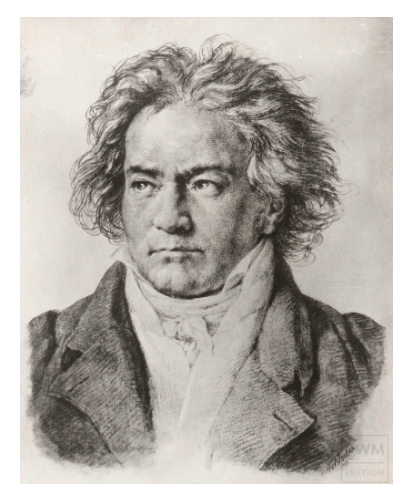
Ludwig van Beethoven had a completely different view on the matter.
He didn’t talk about inventing music.
He talked about following it.
He claimed that a melody does not appear in its finished form. It is not born suddenly like a bolt of lightning splitting the sky. Rather, it is something that must be discovered. Something that appears for a moment and then slips away. The composer’s task, therefore, is not to create a melody out of nothing, but to follow it until he manages to capture it.
In one of his remarkable confessions, Beethoven described the process of composing almost as a chase.
A melody emerges from somewhere deep within inspiration. The composer tracks it down, catches up with it, watches as it slips away and is lost amongst other emotions. He cannot bring himself to let it go. He pursues it with ever-increasing passion, until at last he manages to capture it and give it form.
It’s an extraordinary image.
Because it suggests something we rarely think about.
Perhaps creativity isn’t about inventing.
Perhaps it’s about discovering.
Many artists have described their experiences in a similar way. Poets have spoken of words that simply come to them. Painters have spoken of images that first appear in their imagination. Scientists have spoken of solutions to problems that suddenly emerged after a long period of fruitless searching.
However, this does not mean that creativity is a passive waiting for inspiration.
Beethoven was one of those artists who, over the years, challenged the Romantic myth of sudden inspiration. Although he often spoke of melodies coming to him unexpectedly whilst out walking or in moments of solitude, he was just as keen to emphasise the importance of patient work.
Perhaps that is precisely why his hunting metaphor is so apt. A hunter does not create the game. However, he must possess the knowledge, experience and patience to find it.
The same applies to creativity. An idea may appear unexpectedly, but recognising and developing it takes work. Inspiration is the beginning of the journey. It is never the end.
It is as though the most important ideas were not produced by the mind, but discovered.
Beethoven was not a man of sudden flashes of inspiration.
He carried his ideas with him for years.
He kept returning to them.
He reworked them.
He allowed them to mature.
He walked. He was silent. He kept returning to the same themes.
It was only when he found the right rhythm, the right tempo and form that he would write down the notes.
When asked about the source of his ideas, he replied with disarming honesty: I don’t know.
I don’t know where they come from.
They just appear.
Most often during solitary walks, in the woods, at dawn or at night.
It would be hard to imagine a more surprising response from a man we are accustomed to portraying as the very symbol of intellectual genius.
And yet it is precisely here that one of the greatest mysteries of creativity lies.
For even the greatest creators did not fully understand their own inspiration.
In this sense, Beethoven was surprisingly close to philosophers.
Arthur Schopenhauer described the process of a thought’s birth in almost exactly the same way. He wrote that when a vague idea arises, he drops everything and begins to pursue it like a hunter tracking game. He follows it round every bend, trying to cut it off, until at last he manages to capture it and put it down on paper.
If Beethoven hunted for melodies, Schopenhauer hunted for thoughts.
One tracked down sounds.
The other, ideas.
Yet both described the same process.
First comes the trace.
Then the pursuit.
After that, a moment of doubt.
And finally, the joy of finding something that, for a moment, had seemed elusive.
Contemporary psychology of creativity also highlights this paradox. We now know that many creative processes take place beyond our conscious control. The mind works on a problem long before a solution comes to mind. That is why the best ideas so often come to us whilst out for a walk, in the shower, whilst travelling, or just before falling asleep.
This does not, however, mean that creativity is purely a matter of chance.
Beethoven knew this only too well.
A melody might have emerged of its own accord.
But discovering it required immense patience, attention and hard work.
Inspiration was the starting point.
Never the end.
Perhaps that is precisely why creators so often say that they do not invent their works.
Perhaps they do not create them.
Perhaps they simply find them.
And the whole trick is simply not to lose track of them.


